Built to Validate. Ready to Deploy.
Reference products are complete, working system implementations of the Audality platform.
They are designed to remove uncertainty—showing exactly how wireless audio performs in real environments, at system scale, with synchronization, range, and reliability fully realized.
These systems serve two distinct but aligned purposes:
- OEM Evaluation - validate performance, confirm architecture, and accelerate development using proven system configurations.
- Direct Deployment (Limited) - Deploy complete systems without custom integration, using the same platform and configurations used in OEM development.
Real Systems, Not Demos
Fully functional configurations—not reference diagrams or isolated components.
System-Level Validation
Evaluate latency, synchronization, RF performance, and topology in your actual environment.
Direct Path to Product
What you validate here maps directly to embedded modules and OEM implementations.
Available in limited configurations for evaluation and direct deployment.
SYSTEM BUILDING BLOCKS
A Small Set of Building Blocks. Configured into Complete Systems.
All reference systems are built from a consistent set of components—designed to be combined, scaled, and adapted without changing underlying behavior.
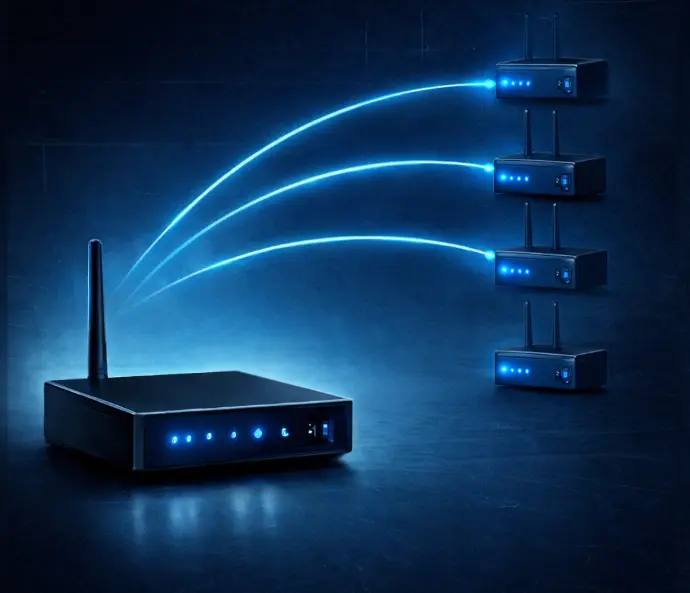
Enclosed Transmitters & Receivers
Flexible distribution. Deterministic behavior.
- Each enclosed transmitter supports of our receivers (up to four)
- Systems can scale using multiple transmitters
- Multi-transmitter systems require coordination to ensure interoperability
What this enables
- Point-to-multipoint audio distribution
- Zoned and distributed architectures
- Scalable systems without rewiring
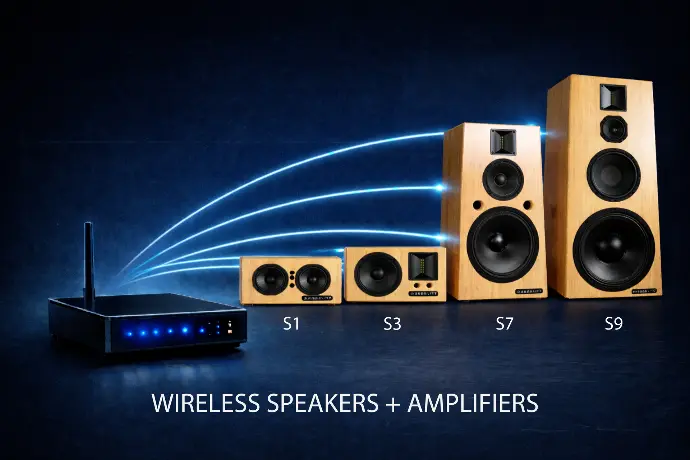
Wireless Amplifier Speaker Systems
Integrated wireless + amplification. System-ready.
Reference speakers integrate wireless receivers with onboard amplification:
- S1 → AAM50125W
- S3 → AAM50225W
- S7 → AAM50600W
- S9 → AAM51200W
System behavior
- Pair any of our enclosed transmitters with any of our speakers (up to four)
- Mixing speaker models is fully supported
- Systems scale by adding transmitters and speaker groups
What this enables
- Rapid deployment with minimal integration
- Performance tiers within a single system
- Direct mapping to OEM product architectures
From Simple Systems to Scaled Deployments
Audality systems scale predictably from small, self-contained deployments to large distributed systems—using the same core building blocks.
Each configuration below reflects a real, deployable system, not a theoretical topology.
Single Transmitter System
Contained system. Immediate deployment.
- 1 transmitter → up to 4 receivers or Audality speakers
- No coordination required
- Fully synchronized system
- Connect receivers to any powered speaker
Typical use cases
- Outdoor patios and small venues
- Retail or hospitality zones
- Home or specialty systems
Why it matters - This is the fastest path from zero → working system.
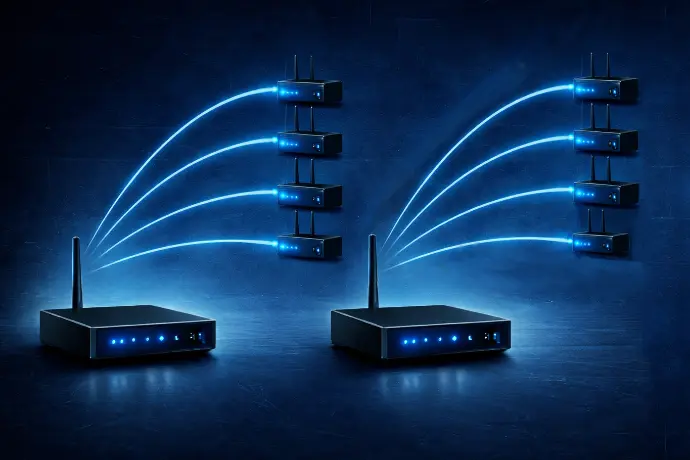
Multi-Zone System (Multiple Groups)
- Multiple systems. Coordinated operation.
- Multiple transmitters, each serving up to 4 endpoints
- Independent or coordinated zones
- Shared or separate audio sources
- Typical use cases
- Restaurants and hospitality spaces
- Commercial multi-room systems
- Campus or facility-wide audio
Why it matters - Expands coverage without changing system architecture.
SCALED DISTRIBUTION SYSTEM
Scale coverage by adding coordinated transmitter groups.
For larger environments, Audality systems scale by adding additional transmitters—each supporting its own set of receivers or wireless speaker systems.
This allows coverage to expand across broader physical areas while preserving the same core system behavior: low latency, reliable links, and tightly synchronized playback within each transmitter group.
Key Points
- Multiple transmitters, each supporting up to 4 receivers or speakers
- System scale increases in predictable 4-endpoint groups
- Transmitter coordination is required in larger deployments
- The same platform supports small systems and expanded infrastructure
Typical Use Cases
- Sports fields and stadium perimeters
- Outdoor entertainment areas
- Campus and facility-wide audio
- Large commercial or hospitality environments
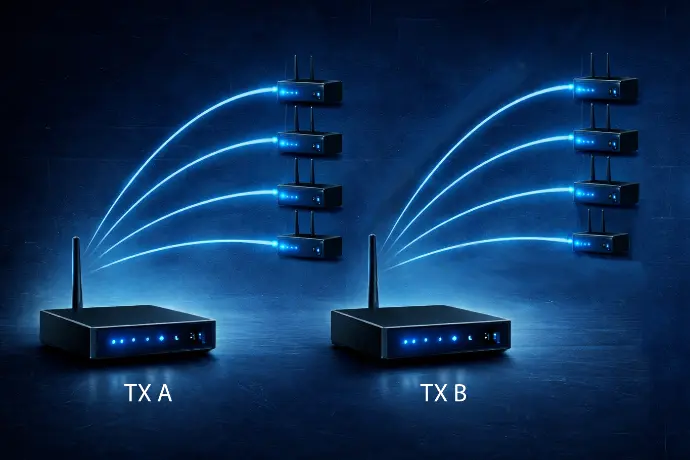
Example 1: 2 transmitters → 8 total receivers or speakers, organized as two coordinated 4-endpoint groups.
Example 2: 1 transmitters → 4 Audality-enabled speakers7
HOW TO USE THESE SYSTEMS
From First Signal to Full Deployment
Reference systems are designed to move you quickly from evaluation to real-world deployment—using the same architecture at every stage.
There is no handoff between “demo” and “production.”
The system you validate is the system you build on.
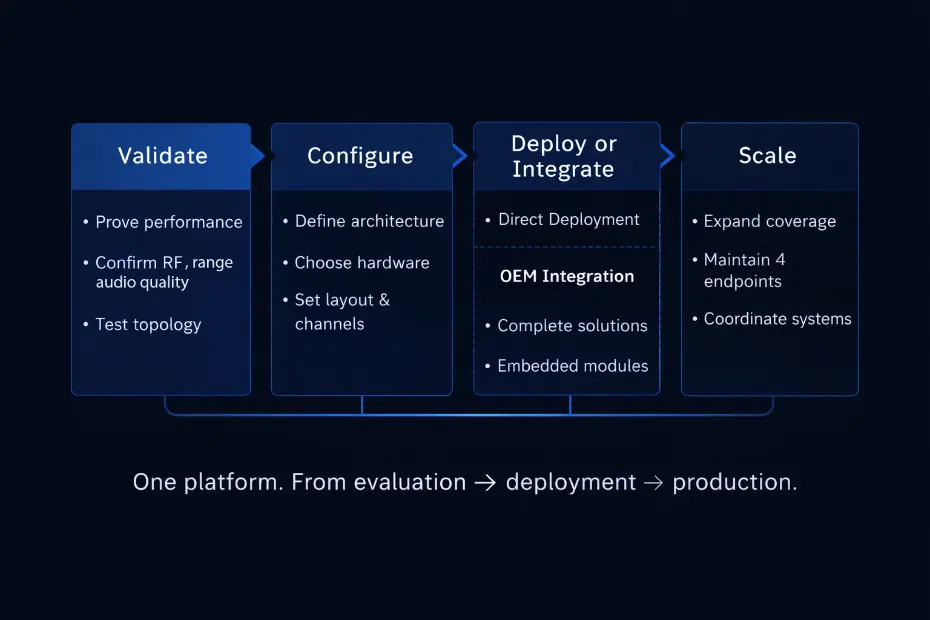
Validate
Prove performance in your environment.
- Confirm RF range and reliability
- Verify latency and synchronization
- Test topology (single transmitter, multi-zone, distributed)
Outcome: Confidence that the system behaves as expected in real conditions
Configure
Define your system architecture.
- Select transmitter count and placement
- Choose receivers or integrated speaker systems
- Determine channel count and system layout
Outcome: A clear, working system design
Deploy or Integrate
Two paths, same platform.
Direct Deployment
- Use reference systems as complete solutions
- Ideal for installations and immediate use cases
OEM Integration
- Transition to embedded modules and custom designs
- Align with mechanical, electrical, and industrial design
Outcome: A system in the field—or a product in development
Scale
Expand in predictable units.
- Add transmitters to extend coverage
- Maintain 4-endpoint groups per transmitter
- Coordinate systems for larger deployments
Outcome: Growth without redesign
SCALED DISTRIBUTION SYSTEM
Designed for Integration. Available for Deployment.
Audality reference systems exist to accelerate OEM development—not to compete with it.
They provide a clear, working implementation of the platform so engineering teams can validate performance, define architecture, and move directly toward production.
At the same time, these systems are available in limited configurations for customers who need a complete solution without custom integration.
HOW TO THINK ABOUT THESE SYSTEMS
For OEM Teams
- Validate performance in real environments
- Define system architecture with confidence
- Transition directly to embedded modules and production designs
For Direct Deployment
- Deploy complete systems without custom engineering
- Use the same platform proven in OEM development
- Expand systems over time as needs grow
Audality enables your product. It does not compete with it.
Available for evaluation and limited direct deployment.
System configurations and availability are structured to support both OEM development and selective direct use—without overlap.
NEXT STEP